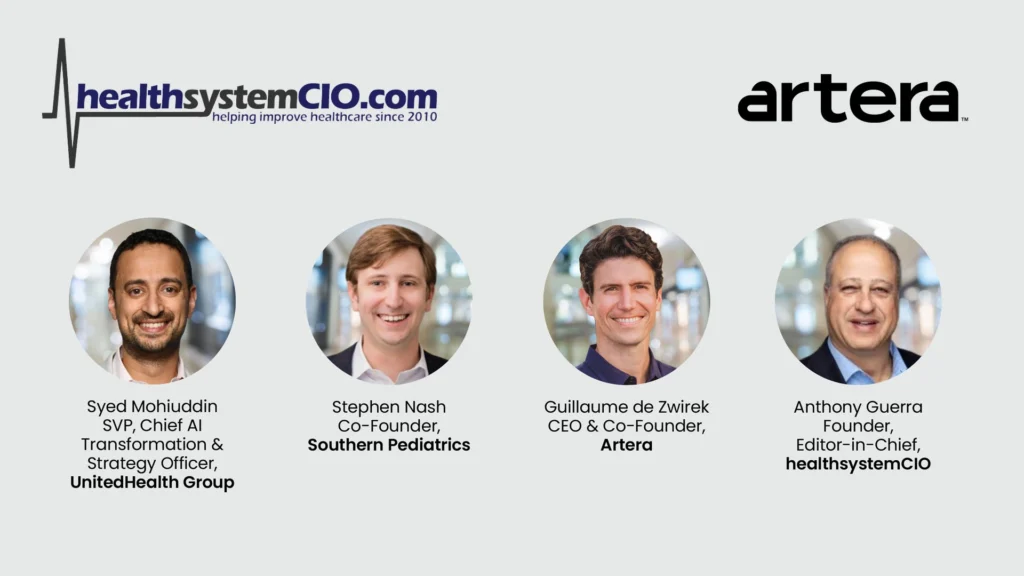
Anthony Guerra: Good afternoon, and welcome to “Maximizing value, Minimizing risk, Operationalizing an Agentic AI Strategy,” a health system CIO production sponsored by Artera.
Just a little housekeeping before we get started. My name is Anthony Guerra. I’m the founder and editor-in-chief of healthsystemCIO and will be your moderator today.
We’re looking forward to your participation. Syed Mohiudden, SVP and Chief AI Transformation and Strategy Officer with United Health Group, Stephen Nash, co-founder of Southern Pediatrics, Guillaume de Zwirek, CEO and co-founder with Artera. So let’s jump right in. Syed, you want to start? Give us an overview of your organization and role, please.
Syed Mohiuddin: Sure. I lead AI transformation and strategy for UnitedHealth Group. We are a, I think you could say, a fairly scaled player in health care, both on the payer and provider side. Our payer business, United Healthcare, is in all major lines of business. Our healthcare services and delivery business, it has, you know, pharmacy, kind of care delivery, as well as kind of solutions and analytics and insights, kind of classic core payer and provider ops solutions that you might imagine. And my role is basically two things. One, it’s classic enterprise strategy. What are we prioritizing? How much capital are we deploying against it? How are we thinking about partnerships, acquisitions, etcetera? And two, then let’s go deep in each of these businesses or business is based on what those priorities are and figure out, you know, how do we actually transform the business? So whether that’s an ops transformation, something around, you know, using AI dramatically accelerate a value -based care agenda, given it’s sort of strategic imperative for the company, that kind of thing. That’s essentially what I do.
Anthony Guerra: All right. Excellent. So thank you. Stephen?
Stephen Nash: So my name is Stephen Nash. I’m the co-founder of Southern Pediatrics. Our mission at Southern Pediatrics is to accelerate access to comprehensive pediatric care, so all children have the opportunity to thrive. We launched Southern Pediatrics early last year, so we’re a relatively new healthcare company, but work with around 75 pediatric providers
throughout Middle Tennessee, serving a little more than 100,000 children today. Our goal is to not only only deliver exceptional primary pediatric care, but also integrate other services that kids need, but often do not receive today, whether that be mental health, behavioral health, social work, and sort of other services, and do so with a focus in underserved areas where there are a lot of access issues for quality pediatric care. My role as a co-CEO is to help sort of set the strategy, the operations, and sort of the execution. And prior to Southern Pediatrics, I was co-founder and COO of a multi-specialty care company called Upper Line Health, which we launched in 2017, started with a few clinics in Alabama and then grew that several hundred clinics throughout the United States, participating in a full value-based care array. So I’ve seen especially care and primary care sort of fee-for-service and value-based care throughout my career.
Anthony Guerra: And Steve, what would you say your relationship is with the technology? Do you have like a CIO type person or do you somewhat function in that role?
Stephen Nash: Right now, a dedicated and prioritized approach. So a lot of what we’re doing, particularly as we grow in these beginning phases, is trying to build sort of an industry-leading organization for them to be empowered and to work within.
Anthony Guerra: All right. Very good. Gui?
Guillaume de Zwirek: I’m in the company of Giants. You should have had me to go first, Anthony. My name is Guillaume. I co-founded Artera about a decade ago. We are in the business of customer service and healthcare. So, trying to improve the relationship with patients, their caregivers, and the back and front office staff at all sorts of organizations.
You know, we got our start by introducing two-way conversational texting and health care. Obviously, the world has changed a lot in a decade. We’ll be talking about some of that today with AI, but it’s a pleasure to be here. So thanks for having us, Anthony.
Anthony Guerra: All right. Excellent. Okay, let’s jump right in. Syed, let’s start with you. How strong is the push to deploy AI agents? What are the market and business dynamics creating this need?
Syed Mohiuddin: Well look, it’s a pretty unique moment in US healthcare. We all know it’s a 4.9 trillion dollar sector, where you’ve got tremendous headwinds on the payor side, you’re dealing with V28, you’re dealing with, you know, rising medex, you’re dealing with coding optimization from providers that’s enabled by AI…and both providers and patients or members that are really frustrated with the friction in the system. And meanwhile on the providers side, you obviously, you know, it’s really hard being a doctor, there’s a lot of administrative morass that you have to overcome, a lot of frustration that you have with the payer. There’s, you know, and honestly, a lot of times you’re dealing with information asymmetry and folks sometimes not maliciously, but often operating, you know, with a need to leverage information asymmetry arbitrage. And what that does is create a situation where you say, how can we meaningfully simplify this, how do we do our work in a more friction-free way, in a more efficient way, so you’re not rolling through ream upon ream of 100-page documents that you need to cross-reference and make sense of. But then how can you really offload a lot of the effort and thinking so that you’re focused on just the high-value things? And that’s where these agents come in. They literally can do human tasks. And when agents can coordinate and orchestrate and execute more and more complex tasks, then you make the life of the operator that is overwhelmed and the person who wishes they could do better with less resources, you know, that much more effective. So long story short, there is a burning platform for change in our industry and need for progress. And now there’s a technology and a set of technological capabilities that are only getting stronger by the day from a governance standpoint, from a how well they work standpoint, to kind of help.
Anthony Guerra: All right. Excellent. Very good. Stephen?
Stephen Nash: Yes. I think this question is probably depending on which stakeholders you would sort of ask within the organization. I would say on an executive level and with our goal to really make sure that we have sort of an efficient organization but also investing our sort of time and resources and things to sort of expand our capabilities. We definitely recognize and sort of believe that the world is going to pretty substantially change with AI agents and those capabilities. I mean, want to make sure that we’re sort of providing new solutions that some of these capabilities can provide. I would say from the clinic level, though, there’s a healthy degree of sort of skepticism or sort of concern. I think from the provider standpoint of how is this going to impact my relationship with patients, how is this going to impact clinical decision making, the staff thinking about this, how might this impact their sort of job responsibilities, but also, I think with health care, a lot of times we can focus on the instances where something might not go right because it impacts sort of a patient versus all the other times in which it went, which it did do sort of the right thing. So I think at sort of working with our clinics each and every day, there is some apprehension about exactly what is this going to mean and change in health care as hard. While at the same time, from an executive sort of strategic level, we kind of recognize that you need to be a part of this change and try to help lead the change if you’re going to really sort of make it worthwhile with a new organization. All right.
Anthony Guerra: Very good. Gui?
Guillaume de Zwirek: We think it’s existential. I mean, and this is coming from somebody who was an AI skeptic in the early days of ChatGPT. I’ll never forget one of our board members who is phenomenally an intelligent woman, had AI put a deck together for her, for a team presentation. And I remember she showed it to me in the very, very early days of, you know, LLMs, and I kind of started laughing. And I felt bad. I was like, this is not that good, you know, like, I know you can build a presentation a hundred times better, but those were the early adopters who understood where this was going in the belly of the beast, right, in one of these MAG seven companies. And it took, I think in healthcare, outside of maybe the ambient scribe space, it took some of us a little bit longer to see the promise. I think what the ambient scribe space did that most people don’t understand is that you had human validation. No note was getting pushed through. Every doctor had to review every note. In our space, in the customer service space, the vast majority of conversations are synchronous. You don’t have the benefit of a human reviewer who can monitor a thousand conversations in real time, right? It has to be perfect from the get-go. There can’t be hallucination. And as the technology has progressed, You know, there was a moment in time, end of last year, early this year, where we realized that, you know, I think the chasm had been crossed in terms of safety and security and efficacy and is this, you know, in certain use cases as good as a human. So we think it’s fundamentally going to rewrite the vast majority of technology investments that health care providers have made. You know, everything from how the code is written, right, with AI coding tools to how the product is delivered in terms of agents as, be the most transformative technology shift that we’ve seen since, you know, the steam engine.
Anthony Guerra: All right. Very good. Next question. We’re going to go with Stephen on this. Where have you or where do you plan to deploy agents in your environment?
Stephen Nash: Yeah. So we have a couple different areas where we’re looking at sort of deploying agents sort of within our systems and capabilities. I think a little bit how I think about this question is less sort of where do we think agents can be deployed, and more around what are existing problems that we think AI agents offer new solutions for that we weren’t previously able to solve. And I think given some of those dynamics I mentioned earlier in healthcare operations, I think deploying agents to be able to say, hey, we’re an organization now with AI agents but are not really targeted at problems, are going to create some operational friction, rather than saying, hey, for years, we’ve always had this issue, and we’ve always had this problem. We’ve tried to solve it before, but now we have fundamentally new resources, new capabilities to be able to do that.
So, you know, two of the top areas that come to mind is charting. We have spent a lot within our organization to make sure our providers have an efficient way to chart and document and spend more time with families, but AI scribes and some of those things can offer a whole, whole sort of next level to that efficiency, and really help to try to solve some of that administrative charting problem or communication. We’re in pediatrics. We have a lot of sort of young families who expect communication and healthcare to be similar to what they experience as a consumer, to expect to be able to have two-way messaging and sort of quick responses back and forth from their clinics, and are able to sort of partner with being able to soon introduce some of those communication capabilities as well. So I think for us, charting and communication are some of the two areas we’re looking at first, but it really stems from what were problems we had before and now what new capabilities do we think are available to us through AI that we want to better solve those existing problems.
Anthony Guerra: Stephen, how do you think of the relationship between generative AI and agentic AI. Do you see them as quite separate, or do you see sort of one flowing into the next or them working together to create a solution to a workflow challenge or a communication challenge?
Stephen Nash: I personally probably, I see them sort of flowing together, sort of part of sort of an iterative sort of part towards sort of moving towards that solution there. But I think where I struggle a little bit to answer this, I think the pace of change is just so rapidly. So if we were having this panel even six months ago, I think we would have some sort of different responses. And I imagine if we had this discussion six months from now, it’s going to continue to change. I’ve not seen the pace of change be as rapid, even on the AI scribe piece where a lot of companies for, you know, investing in AI scribe partners and now EMRs are building these native within their systems as well. So I do see them as sort of working hand in hand, but I just, I imagine this is going to continue to evolve pretty quickly.
Anthony Guerra: Very good. Syed, what are your thoughts?
Syed Mohiuddin: It’s going to be similar for everyone. And I think the way Stephen talked about it, I think makes a ton of sense in the sense that you look at, what are the main problems that we have as a company? Where in general would LLM capabilities – to your point about gen AI – help accelerate or address that? Where in those areas is there high task burden? And then let me think about how to leverage agents to get that. A couple of things before we think about how to deploy or what to deploy, I do want to emphasize where obvi talking to tech community, making sure its leveraging MCP or just as you think about essentially tech doing what humans do or helping humans do what they do, but literally as task partners, if you will, almost as colleagues, an extension of the workbench, an extension of the team, you really have to be thoughtful on your governance, on your design, on your observability, on understanding what you’re actually putting out into the ether. In the same way that you would do diligence on a hire, on the same way you would train a hire, on the same way, you know, there’s an equivalent version. It’s not the same, but there’s an equivalent version for agents you have to work through.
You gotta start in a pilot or experimental mode to figure out what works, how you work, how you make it all work before you scale, but design it to scale. With that said, we have administrative cases, we have clinical cases, we have a bunch of things…one kind of interesting thing I might point out is we’re building, you know, frankly specialized agents not only across a lot of our administrative processes, but also to just simplify things and complete tasks.
So think about research, right? If you’re doing internal research, how do you leverage an agent? If you’re trying to understand, hey, why did my claim not pay and what can I do? Can we try formulary alternatives and benefit, can step therapy, et cetera? Can we, you know, can we perform a vacation override in a scenario on the pharmacy side? Think of them as explainer and action use cases; we’re seeing a lot of that, so research, explainer use cases, action use cases in addition to the standard administrative plays that you might see.
Anthony Guerra: Alright, very good. Gui?
Guillaume de Zwirek: You know, I was so consumed. I actually forget what the question was, Anthony.
Anthony Guerra: Well, it’s where do you have or where do you plan to deploy agents? So when I pose that to you, I would say, what are you seeing when you’re having conversations with people and customers, and potential customers? Where do you see them? You know, the, um, Syed talked about and Stephen talked about, start with the problem and then figure out if the technology solutions can work towards it. In the context of the discussions you have, what are the problems people are articulating?
Guillaume de Zwirek: Yeah, well, I mean, so you heard what you’re hearing from Stephen and Syed totally mirrors what we see in the market. What are the high-volume mundane tasks that people tend to push off? Those tend to be the prime targets or where do we have a burning pain where we need a different solution? So in the pediatrics world, a good example would be a well-child visit, especially depending on how you’re reimbursed – Syed, knows a thing or two about that right, so it’s got to happen. I think it’s roughly every year, Stephen, keep me hones,t I cover like 100 different specialties, so sometimes I merge specialties, um but as Stephen’s business scales, as he goes from 100,000 patients to 10 million patients, making sure all 10 million of those patients know that they’re overdue for well-child visits becomes a hairy problem. And the front desk and back desk, you’re not, most folks are not processing a call list every single day and sending one-way campaigns, you could. So we’re seeing use cases like WCC, AWVs, mammograms, colorectal screenings, care gaps that tend to fall off the side plate, get automated at scale. Imagine you realize, you know, you’re, you need to attest to certain measures for your reimbursement. Again, that’s Syed’s corner of the world, and you’re way behind on your mammograms in a certain area for your value-based care plan. You can have an AI Agent call 100,000 women in 30 seconds and guide a good chunk of them – probably 40% them – through to a successful scheduled outcome. No human could ever do that in that time window. So thats a great example fot ypes of use cases that were never possible before. I think Stephen mentioned this, Syed mentioned this.
And I want to touch on one other point, Syed mentioned about kind of governance and piloting and pre-deployment and post-deployment measurement. I think this is critically important. And since we’re early, sometimes the best comps are outside of our industry. And I don’t think AI scribes are a good comp for Agentic AI. Where I would turn everyone’s attention is to actually the AI coding space. The AI coding space is a couple cycles, maybe a couple years, I hope we move very quickly ahead of where Agentic AI is. And, you know, if you’re a health system CIO,
I think most of you probably have developers or you contract with developers. You know, I would make sure they are using AI coding tools. You will learn so much about governance in that process. You know, most of our engineers, their code is written by ClaudeCode. There’s cursor, there’s GitHub co-pilot, there’s a bunch of other tools. But then the PR cycle, where they review the code that’s been written becomes critically important. And it’s more important to have amazing architects who are reviewing code that’s being written, simplifying it, so you don’t end up with spaghetti in production. Our biggest challenge, when we started introducing AI coding, was actually the on-call engineers – something would break, they’d look at the code, and they’d go “what the heck was written here?” So, the attention to detail up front and the control cycles with PRs became critically important. I believe we’ll see a very similar paradigm play out in healthcare. So I think looking to other industries can be helpful here.
Anthony Guerra: So Gui, what’s the upset of that or warning flag for Cios in health system? It Sounds like on some level you’re alerting them to a possible danger if they go down the wrong road or if they do things without thinking through what needs to be reviewed. So what is your warning, just to be a little clear here to them?
Guillaume de Zwirek: Well, I think there’s a blueprint here. And I think part of the challenge is that you need to be AI-fluent to be able to make the proper decisions. So Syed didn’t mention these by name, but he alluded to this. In the agentic AI world, there’s concepts known as evaluation and judges, which always need to be deployed before anything goes to production, and ideally in real time when these agents are working in production. And what those two tools do is ensure that there aren’t safety risks, you know, hallucinations, other violations that could create significant patient harm. And that’s just one example. Syed had mentioned model context protocol, that’s another one right like i talk to companies all the time, and there are still people who are layering agents, which is very, I mean that was the mode in January, I think in December of 2025 if you are stringing agents and sub agents together, you really aren’t you know in the in the zeitgeist with where AI is today, you know, model context protocol, A to A, there are a bunch of other standards there emerging that are much, much more effective and promising for healthcare, candidly.
Anthony Guerra: Yeah, it’s a dangerous place to mess around if you haven’t done the research, it sounds like. You can make some pretty bad errors. It makes me think of what people have said about hosting things in the cloud. If you’re doing that yourself or sort of managing it yourself, and you weren’t up to speed, you can make a critical error that will expose you to major security dangers. And it sounds like this is the same type of thing.
Guillaume de Zwirek: We have a 20-person DevOps team. You know, like it is, I mean, Syed, I’m sure yours is even bigger, right? Like, you don’t realize the security patches that are coming through every day. Yeah, no, no, it’s, it’s far bigger than you would think.
Anthony Guerra: All right, very good. Next question, we’re going to start with you, Gui. And I’m looking for you to give an overview, I know you’ve got some thoughts around this framework. Describe the options open to an HDO that wants to leverage agents. Discuss the following in terms of speed to delivery, costs, in-house talent required and risk: building in-house, buying a vendor solution, or sort of a middle ground, partnering with a middleware OEM?
Guillaume de Zwirek: I think it depends on the size of the organization. So I think we’re going to get three really interesting perspectives here. As a vendor, I mentioned that I was a skeptic early in the AI wave. I just didn’t feel like the technology was in a place where it made sense in healthcare and would meet the quality and safety goalposts that are necessary for our industry. the technology is moving so quickly, that changed for us. We actually initially look towards partnership because we felt like, hey, maybe there are some folks that are ahead of us and this industry is moving so quickly. The first step we took was, you know, as I mentioned earlier, becoming AI fluent. So we really understood how these things were built. And then we took into consideration, you know, how much control do we want to have? How much agility do we need in terms of speed to market? How much dependency do we want on other solutions? And then
what will be left if we work with a partner? And the what will be left, candidly, became one of the harriest parts, which is systems integration. You look at the healthcare market, we have tremendous fragmentation, especially in the provider, the private space, right, the specialty space in terms of EHRs, PM systems, downstream systems that, you know, frankly, the agents need access to to complete tasks. And, doing those integrations properly, plugging into the APIs, requesting new APIs when things aren’t available, making sure those are real time and returning the right amount of JSON. That work was going to be with us regardless. So we decided to build everything ourselves.
Now, the challenge with building everything yourself is that it does take longer and It does does cost a good amount of money. I mentioned a 20-person DevOps team. You know, you’re having to create a contract with a cloud provider. You’re having to, you know, pay per token for the large LLM providers, pay for telephony. You’re stitching together a lot of solutions. So managing that for one organization, unless you’re at the scale of a UHG, for example, I think becomes a challenging proposition. That turned us to partnership, which is interesting. I think the key question in partnership is, you know, how much work is left on my plate after I work with this organization. In our case, it was the bolus of work, right? The integration that our partners would expect us to do. So we decided to build it ourselves. I think as a healthcare provider, the key thing I would look for is industry and specialty experience versus horizontal experience because you’re going to be left with two very different bodies of work on your team depending on the choice that you make there. I would also look at the depth of experience. We talked about governance, eval, judges, net news standards, making sure that your partners are on top of the latest and greatest, I think is very, very important if you’re going to be successful.
And then, I mean, I’m kind of mixing buy and partner here. In our world, if I was a health care provider, partner to me would be more about using a horizontal provider, and I can name a couple, Retail, Bland, VAPI, there are a bunch of horizontal providers that you can build on top of. That’s what I would call the partner option. And then buy would be buying from a specialized healthcare team. So to me, build is kind of, frankly, out of the window unless you’re really at the scale of a UHG. I think minimum you’re in $5 million a year if you’re building this yourself and yo’re not going to be world class. It’s a big investment at a significant scale. I think it’s between partner and buy.
Anthony Guerra: Very good, what are your thoughts, Syed?
Syed Mohiuddin: Gui kind of said it, he appropropriatley represented where I sit In that equation, or where my company sits in that equation, more importantly. And I think maybe just the two things, everyone talks about speed. There’s speed to start, which is where external parties can really help you. But speed to completion and to execution, to Gui’s point, depends on what you have inside your house. And so really understanding end-to-end what’s going to be required to get to delivery and impact for your members, for your patients, for your doctors, whomever the effect, the party you’re trying to affect with your investment is really important, right? I think it’s a pretty common mistake to think, okay, well, just because we’re going to partner with so-and-so, we’re going to be able to turn the crank and get X. Well, actually, the last
mile is, or the longest yard is the longest yard for a reason, right? So thinking through that’s really important. That said, speed is essential. So if you do think someone can significantly come in and accelerate your path to impact, then great. The other thing that I would say is there are things that, to Gui’s point about like, we’re going to need to have this in house anyways, it’s not just for your kind of core interoperability or more infrastructure -related stuff. sometimes you have specialized capabilities that when you deploy it at scale will have tremendous impact. So it’s actually worth taking more time and making that part of your secret source sauce, making that an investment into that moat, right? And into making the sort of difference that you want to make. At the end of the day, when I think of this, it’s whether you’re talking about AI agents or you’re talking about, you know, widgets and a generic manufacturing company, how you think about this, it’s a classic strategy question, right? And it’s what are my strategic priorities, what’s going to help me accelerate my path to those, whether it’s partnership, organic, investing in my own capabilities, or it’s an acquisition – is that, do I want to accelerate capabilities? Well, I’m less likely to buy if i’m accelerating capabilities because i’m going I’m not going to get revenue from that whereas I can easily partner and have a vended relationship or vendor relationship. And do I need this to be specialized or not? You kind of ask the same basic strategy questions in any time you approach this partnership question and it’s no different with AI agents.
Guillaume de Zwirek: Syed, if I may ask a follow up question to Syed. My, I think, at least in the agentic AI space, my core assumption is the vast majority of organizations, Yours, Stevens, mines, maybe not the single doc practice, but outside of the SMBs, SMBs, most at some point, if they’re going to build anything, the first thing they should build is at the interop layer, right? Into custom systems. So you talked about model context protocol. That is where the engineers should go first.
Syed Mohiuddin: So it’s literally somebody asked me this question this morning. If you could have everyone in the industry do one thing across the board in 2026, what would it be? It’s get your fundamentals, your foundation right, right? It’s everything from is all my data digitized such that I can extract it. Do I have the interoperability? So not only can I have all my internal data sets talking to each other, but then I can connect with the outside world, e.g. leveraging MCP, but all these other things. But, you know, do I have the right guard rolls in place? I mean, you can dream about getting to the moon, but if you don’t have the building blocks right, you’re not going to get anywhere. You’re not going to get off the starting blocks. So I totally agree.
Guillaume de Zwirek: And I have actually a good practical example. You know, we’ve integrated our agents into, I don’t know, seven or eight EHRs. And by the way, with Claude, We can rip these out very, very quick. I mean, we did two yesterday, one hour of cloud code work. Now, it has to go through PRs, it has to go through DevOps, right? So there’s a machine that then takes over. Here’s what’s fascinating. Simple scheduling use case. Patient calls, I need to schedule an appointment, and it looks for slots and it return slots. EMR A, I’m not going to name the EMRs, EMR A return slots, It’s five lines of JSON. EMR B, do you know how many lines of JSON it returns for the exact same query?
Syed Mohiuddin: Thousand.
Guillaume de Zwirek: Yeah, it’s 3,000. Think about latency, think about performance, right? Like, there’s actually fundamentals that are not properly set up for AI in healthcare. I mean, the cloud, Anthony, we talked about the cloud earlier. The cloud is one. You kind of have to be in the cloud, and we’ve got to leverage standards like fire, we got to think about interoperability, and then we’ve got to keep people honest on five lines of JSON versus 3,000. I mean, then we’ve got to do a bunch of work on our end to parse that down and try to make it performance, right, to make sure that it meets the safety and security requirements. Anyways, I’ll get off my high horse, but the fundamentals are so important.
Anthony Guerra: I want to go back to that, Gui, but I do want to give Stephen an opportunity to comment on anything that’s been discussed here so far.
Stephen Nash: Yeah, I think I agree with a lot of the comments, sort of made so far. I think, you know, from the healthcare organization standpoint, I guess I always, I would agree. I think, you know, partnering is going to make a lot more sense than sort of the buy or build and being able to have sort of the resources or the expertise to do that, not only well to start, but to continue to sort of adapt and evolve how quickly sort of the industry is sort of moving. But I would say from a health care organization standpoint, I think there’s going to be, given that there’s some natural sort of apprehension, I feel like a lot of organizations are going to feel like they’re behind and then rush to sort of start. And I think that they’re, what’s really important and what we’re trying to do is a little bit here, just given how quickly things are doing, you do have to sort of make bets on different vendors and partners and who are going to be the ones that are going to stay three steps ahead and continue to kind of be leading this change. And ultimately, you want to sort of have as comprehensive of an integrated sort of system as you can. So trying to be really intentional, sort of really starting now with who are the partners that you think are going to be the right ones that you’re not always trying to play catch up or trying to rush to get caught up to what people are now asking for, wanting or expecting, but finding really those right partners that you think are sort of leading the way. and sort of trying to sort of see the whole playing field. I think, you know, to the comment that we mentioned there, I’ve worked with dozens of EMRs, right? Most of them still have an issue just telling you how many appointments are scheduled in a single day. That is simply not going to work anymore as we move to some of these AI capabilities, right? And I think, you know, I think that there’s going to be a world where there’s a bigger and bigger gap in experience. And there’s going to be this tipping point where providers and staff are going to be demanding some of these capabilities that they see that their peers have. So I think my biggest advice on this a little bit would be partnering, but being really thoughtful now, anticipating where things are going, what the organization needs holistically and how these things, you know, integrate and connect to each other, getting that foundation right, as I had mentioned. But also, you don’t just want to pick a partner who can get you from A to B quickly, you want to pick the partner who can continue to sort of lead on that capability as well.
Syed Mohiuddin: Would you agree with Gui and I that, hey, it’s kind of all for not if you can’t connect to the ecosystem, i .e. start with interoperability?
Stephen Nash: I think that’s 100% right. And I think there’s a few. I actually, I think there’s a world on where there’s just going to be far more concentration in the EMR space or the systems that can do that first can’t do that. To be honest, and I think that’s, that is such a big change in healthcare that I would be, you know, as thinking about it, some of these capabilities are interesting, you need to start with that first sort of foundational system. We’re really fortunate to partner with Athena Health as an EMR, and it gives us access to not only custom workflows and data accessibility, but we know that they’re on the leading edge.
Guillaume de Zwirek: Stephen you said it. They were five lines of JSON, okay?
Stephen Nash: They were, they were the, I was smiling, I think that was our use case. I were working with your team on Artera on some of the scheduling sort of piece of that there. And I think, um, picking, and
Guillaume de Zwirek: by the way, they were one of the first to announce an MCP server, right? So there’s a part of, part of what I heard you say, Stephen is like, get in the arena, right? Like, you need to be playing with AI now, even if it’s a limited use case. So you understand how it works. You can lobby for the right things. And you can set up your organization to be ready for rapid scale. Let’s not make the same mistake we made during COVID, where overnight you had to deploy video conferencing, and most people had to rip that out two years later and actually think about the right way to do it that could scale in a way that wasn’t hemorrhaging cash out of business.
Stephen Nash: Yeah, and that’s where I see this operational tipping point really in health care is that we might be almost too responsive to some of the caution right now. And then we get to sort of middle of next year. And then all of a sudden, everyone is requesting, asking, demanding this. And then we have to go back to the organization and say, yeah, we’re on an EMR, where we can’t even begin to have this conversation. We now need a year to get into the right system. Now we have to pick the right partners in your so far ahead. So I think it is sort of anticipating and understanding where things are going and helping to make sure your organization is ready, particularly when there’s going to be a lot of demand and interest for these cases.
Guillaume de Zwirek: And Stephen, would you agree that it’s not as simple as choosing a partner that you outsource something to? This isn’t taking it off your plate. To me, my fundamental belief is you’re picking a partner that you’re going to learn from that’s going to lead you to water with them. I mean, I had a conversation with Anthony a couple months ago, and coming out of that, I actually started a newsletter on all the things I’m reading in AI and why they matter. Like the one coming out next week is going to be, I don’t know if you’ve heard about this, but virtual MCP servers, which is an interesting kind of middleware between the MCP and the patient, or you know, the human, which makes it far more efficient. Anyways, we’re getting too technical
Syed Mohiuddin: I want to read your newsletter!
Anthony Guerra: Yeah, how do we get this newslettter?
Guillaume de Zwirek: Well, I’ll add you to the distro.
Anthony Guerra: All right. Beautiful.
Guillaume de Zwirek: Is this an explicit opt-in?
Anthony Guerra: Yeah, I’m opting-in.
Syed Mohiuddin: I am in. It’s like health tech nerds 2.0. Let’s go.
Guillaume de Zwirek: Not as good. I got work to do.
Stephen Nash: I think I would just add a little bit, you know, to that point, you know, we’re a really proud and excited partner with Artera. But that decision was not just, oh, we recognize what Artera care can do today from a communication standpoint, But we don’t want to have a dozen different partners. So we’re thinking about which is the ones who can be best equipped to be able to meet the variety of different problems we have, have multiple use cases, and continue to be able to sort of evolve that technology. And I think it’s making those bets on those more strategic leading partners that you have confidence that you’re not going to fall behind on. And I think for us, we’ve made two kind of big bets between Artera and Athena as two of our leading partners, but that’s going to be able to cover the vast majority of our use cases outside of internal sort of administrative sort of use cases. So I think, I sort of how you choose and being really thoughtful on that can get you a long way as well.
Anthony Guerra: Alright, wow. I’m going to, I’m going to ask for a little education here, Gui, and maybe some people on the call will appreciate it as well. So what I’m fascinated by here is this discussion around going and looking at both. It sounds like both are foundation of our organizations. And let’s take this from a health system perspective. We talk about being foundationally sound in order to embrace and deal with and leverage AI capabilities. You mentioned this dynamic of JSON, and I know that’s a technical term, an application that returns more than you expect is somehow deficient or weak or old school and not modern. It’s not going to play well in the modern world. Athena Health used in and Artera examples of organizations
that are well structured. So if those are your vendors, you’re in pretty good shape, and I assume also if you’re in the cloud, you’re in much better shape, then you aren’t. So I want to, I want you to address this a little more, explain it a little better. And in, it sounds like our positioning as a health system would be largely dependent on the vendors we are using. So we would either be using modern up-to-date vendors or vendors that are not. And what is the implication of not using someone who’s more modern? Where do we hit a limitation down the road that we don’t even realize we’re going to hit now? And the other thing is these investments in some of these core vendors are so significant, you know, we’re probably not going to do a rip and replace just because we’re going to get less JSON code going with someone else. What are your thoughts, Gui?
Guillaume de Zwirek: Well, we might have to, Anthony. I mean, unless we shine the flashlight on the deficiencies today, there might be situations where the entire landscape changes. You know, if agentic AI accelerates at the pace that many of us in the industry think it will, there will be a point where things are just not possible if you’re not on modern infrastructure. A lot of healthcare is still single tenant on prem. And let me be very clear, like, when I say cloud, cloud doesn’t mean you took your server and you put it on gCP right, and you’re hosting gCP, cloud you know in the EHR world would be kind of a modern multi-tenant system with all the proper
security controls so that the APIs from one healthcare provider to the next are the same. Athena is a good example of that, right, we can we can build an mcp server for stephen and southern peds and it will work for the for the you know the oncology clinic next door who wants to leverage a similar system. That clinic might have custom rules and preferences and that needs to be surfaced in a UI, in the application layer that vendors have to build, but that makes it very important.
Now you go where healthcare started, 20-30 years ago, single tenant on-prem, unfortunately there’s a lot of customization and you’ve got to connect to every single database one by one by one. That creates security vulnerabilities. It allows a lot of time for the process. Has anybody ever set up a VPN, right? It can take two hours. It can take two months. And like
competency plus competency, not just of your team, but of your actual vendors, like do you have Cisco? Do you have somebody else who are you assigned? It can become an absolute nightmare. So, you know, take that times 10, and that is the uncertainty and that is the agility that you lose. So I think modern infrastructure is important. When you think about agentic solutions, performance in real time is very, very important. Syed, if somebody has a question about a claim, right, and something just came through five seconds ago on that claim, but your agent can’t access that information, you’ve just squandered an opportunity with a beneficiary,
right? And you’ve created a lot of confusion. You’ve created cost. They’re going to complain. They’re going to write a letter. It’s going to go to Syed’s team, right? And it’s going to be a complete nightmare. So you have the opportunity to create a lot more harm than good if you don’t have real-time performance. There’s another vendor that, again, I won’t name the vendors, where they limit the number, and I’ll stick on the scheduling use case. They limit you to looking at slots five days out. There’s a limitation on their API. You cannot look out for open slots
more than five days. So now we’ve got to build. Now we’re putting band-aids on this solution, scalable band-aids, right? But we’re having to parallelize like 100 queries. You look at pediatrics. Stephen might be booking an appointment a year out. I now have to run, you know, what’s 365 by five, right? I have to run like 70 concurrent queries, slot that all up, streamline the JSON, that adds latency, that adds time. If I’m on the phone, if I’m texting, and that takes too long, you will lose me. Right? And I’m going to put a tax on your call center. So I think I’m giving you real-world examples versus how to fix it. And the only way to know what’s broken, I think to our earlier comment, was to get in the game, right?Figure out what is possible with your existing system, lobby with those providers to modernize, right? Because you have time to do that now. And then prepare a plan B if you need to. I mean, I think, I think agentic AI could fundamentally change the role of EMRs in health care in the next three to five years. So I think it’s critically important that folks are experimenting and understand what is possible.
Anthony Guerra: Very good, Syed.
Syed Mohiuddin: I’m going to co-sign every word that Gui said. I think he’s spot on. I don’t, you know, I don’t have a ton to add to that. I think that was exactly spot on.
Anthony Guerra: Stephen.
Stephen Nash: I think the only thing I’m going to add to that as well, and I know I was speaking to a lot from sort of the healthcare sort of clinic operation sort of piece of it, but I think as executives, as leaders, we have the responsibility to our organizations to try to anticipate where this is going and where we think things are going rather than necessarily waiting for the demand within the organization. And I think that that would just be the other part that I would add about this is things are going to evolve so quickly. Things are going to keep changing. So you have to be nimble in that vision and that strategy. But I think waiting for it to come to you as an organization and this type of change, we’re going to be really far behind. So taking those steps even now, thinking about where it’s going to go, I think that’s our sort of responsibility as sort of executives is to sort of be anticipating this and to be trying to put forward sort of a strategic vision for our company and sort of marching, marching towards that and being nimble, not overwhelming people with introducing this, but we have to, you have to start preparing and equipping yourself now and thinking about this now. Otherwise, it’s going to be overwhelming to play catch up.
Syed Mohiuddin: And the only thing I’d build onto that to, and I completely agree with Stephen, it’s got to be leader led, and frankly, you see it with Stephen, you see it with Gui, it’s got to be CEO led. We certainly said that to our CEOs they have taken that uh you know Andrew before, and Hemsley now taken that by the horn, and it’s been really incredible and inspiring to see, um the thing though is the part of that is then driving it through the org. So getting everyone to have familiarity and fluency with this, I mean, in our case, formally making sure that everybody goes through training, certainly all of our executives. And when I say executives, I don’t mean top 10 people. I mean top 1,000 people, right, you know, given our scale. But that everybody really, really understands all the responsible AI components, all the, you know, how does this technology actually work? How do we think it’s going to work in the next 6, 12, 18, 24 months? What are some use cases in the organization today? What are other things that, what could it look like? And then get them playing with it. If it’s just like a reading a book that is way different than getting your hands dirty and get everyone to get their hands dirty, I think that’s really important because at the end of the day, you know, you don’t know where inspiration comes from. You don’t know where great ideas come from. But if you’re not empowering your leaders and your teams to even understand what can this thing do, then the odds of them coming up with the ideas to take full advantage of the technology, setting up the right partnerships, making the right investments, pretty low.
Guillaume de Zwirek: I think I want to make a point because I think some people might hear that and say, well, I use ChatGPT. I use Gemini. This is not, I think, Syed is saying. No. Like, that is not enough. That is, you are behind. If you’re like, yeah, yeah, I use AI. I don’t use Google anymore. No way. Like, I personally installed Claude Code on my terminal. I am not
an engineer, right? But I need to understand how code is written. And I actually have it write documents for me. My board minutes. I actually throw in there. Like, I try everything with AI. And frankly, I’ve learned important lessons. Like, if you put something into Claude code, it’ll install programs for you. It’ll be like, do I have permission to install ABCDE? And you just say yes or no. And I was sitting next to one of my engineers. And he was like, say no. Like, that can create a security issue. Talk to DevOps. It all has to be like, and I wouldn’t know that unless I had gone through that experience. So you realize, okay, this is like, if our whole company was using this, it would create some challenges. How do we create governance around this? How do we create a process? How do we create the right training? So this is not ChatGPT and Gemini. This is, you’ve got to go far beyond the consumer tools that everyone’s, you know, heard about.
I think the last thing I’ll just add, if it’s all right, just real quick on this is not only anticipating within the organization, but how it’s implemented and really more so how it’s communicated. I think AI is also this known term and everyone has their own perception of this and this idea of it. And it’s less around we’re trying to implement AI and it’s more around we want you to be able to chart as efficiently as possible. Here’s a new tool to be able to help to do that. We want you in the clinic to have every minute possible interacting face-to-face with families and with patients and providing great service. If we can reduce inbound calls, we give you more of your time back. I think as executives too, its important how we communicate these things. I’m not just, even though we’re aware of some of the benefits of AI, that you don’t just let that term stand alone but you’re really communicating it about how it’s connecting to those problems that you’re solving and sort of increasing those capabilities that are related to the mission of what we’re trying to do, which is ultimately paramount in healthcare as well.
Anthony Guerra: Excellent Stephen. Gui, let’s give you a chance to ask one or more of your co-panelists a question.
Guillaume de Zwirek: Okay, um Syed, I think a hairy one that we’re dealing with right now is that you know the pace of change that’s that’s happening the core infrastructure providers right Amazon, Microsoft, Google, you could even throw maybe anthropopic into the mix ocii if you really want to how how are you all fundamentally thinking about, do we need to switch from one provider to another? Like I’ll give you an example, Gemini just leapfrogged chatGPT. Now, we use AWS for some of our kind of core infrastructure but Microsoft seems like they’re in a better position now. And we sit here, and have these like architectural decisions where we think, hey, do we burn a month and move some of this core infrastructure to a new service provider like Microsoft? And is that going to be for not? Because Amazon will catch up three months from now. How are you guys thinking about that tug of war between, you know, these big infrastructure providers?
Syed Mohiuddin: That’s a really good question that we think about all the time. I’ll say maybe three things. One is we are in no illusion that if you’re in the lead today, you’ll be in the lead tomorrow. So we’re not trying to chase the tail. We actually believe in durable lasting partnerships and investing together. Obviously, given our scale, you can get a little bit of white club treatment in these relationships. So that does help a little bit. Two, we also know that they’re all credible and important and valuable in their own ways. So in certain instances, we’re full on with bedrock. And certain, I mean, you know, I think you can guess as an enterprise, if you follow the data, which one, which coding capability we use the most. And then we, we have a developer, but maybe the most important thing I would say is we have a developer environment that, you know, it is on, I’ll just say, one of their chassis, but then gives you access to 32 models, right? By now it’s probably even more. Last Jack, it was 32 models. So we really leave it into the hands of our developers. But basically, and that way we have all of our kind of security and safety safeguards in there, in our kind of closed environment. But, you know, if I were just to step back, Gui, I would say that philosophically, we are appropriately promiscuous in the sense that we are always a little action here, a little action there, a little here, a little there. And through that, you know, we get to understand a bit where we typically only go deep, where there’s lots of evidence, lots of support for, you know, in a durable way, not just to, oh, you had better data today. Yeah, we’re going to test you. We’ll always be testing. When perplexity shocked the world nine months ago, you know, we are not, sorry, not perplexity. When deep seek shocked the world nine months ago, we, our engineers were immediately testing. But that doesn’t mean everything just shifted over. You know what I mean?
Guillaume de Zwirek:Yeah, you’re committed, but you’ve got your eyes on the field because you don’t want to miss any.
Syed Mohiuddin: Yes, and. That’s right. It’s a yes and strategy.
Guillaume de Zwirek: We do a similar thing. I mean, so I’m, I’m glad we haven’t missed anything. We have a bunch of environments running with every cloud service provider and I think there’s always a debate three months in where it’s like we need, like there’s this substantial benefit to this other provider. But then the what if of like, yeah, but these guys will probably be there in three months. Now we’re not…
Syed Mohiuddin: Switching costs are non-zero. So, you know, it’s like, do I really want to deal with all that? And on some level, don’t you just leave it to your developers? Now, from a cloud vendor standpoint, it’s a little trickier. Also, what we haven’t mentioned, let’s just be transparent. It’s what’s the nature of the contractual relationship? And what other freight are you trying to get a contract to carry, right?
Guillaume de Zwirek: Yeah, well, in the cloud service providers, it’s tricky, right? They’re all layering in these added products, which makes them a little bit It reminds me of another technology in the healthcare space, right? So, like, how do your cards write, you know?
Syed Mohiuddin: Tell us what you really think about electronic health records, Gui.
Guillaume de Zwirek: Hey, I’ve been effusive about Stephen’s choices. I actually agree with his choices, but, yeah.
Anthony Guerra: If you’ve learned nothing else today, we have the phrase appropriately promiscuous.
Guillaume de Zwirek: Yeah, that’s right.
Stephen Nash: That’s right.
Guillaume de Zwirek: The headline on the Wall Street Journal today, tomorrow.
Anthony Guerra: Yes, Syed says, I appropriately promiscious, I love it. All right, listen, we’re just about out of time. So I’m going to give everyone an opportunity for a final thought, best piece of advice. As we said, you’re from very different organizations. So the way I would frame it up is to give a best piece of advice to someone in a similar position. So, Stephen, we’ll start with you, someone who’s leading a pediatric practice, a large pediatric practice. what’s your best piece of advice for that individual regarding some of the things we discussed today?
Stephen Nash: Yeah, I would say when you’re thinking about evaluating a partner, I think one of the things that was really helpful for us is a lot of times the partners are going to want to talk very tactical of we can provide this capability that does this from an AI standpoint. And while understanding tactically what they’re offering matters. I think given the space, what we have found most valuable actually is explain to us sort of your strategic vision of where you see AI going and where you see your company fitting into this and where you kind of see this industry moving over the next couple of years. And that’s very hard to do, but really also not just betting the capability itself, but does that partner organization have the right strategic insight, strategic sort of focus to be able to sort of be a step ahead, we think is sort of is really important. And that sort of led us, you know, to some of the partnerships that I mentioned was sort of finding those organizations that are not just doing the right capability, but we think has the right vision, foresight, sort of way to think about this, that they’re going to continue to sort of evolve and sort of be on the front end of that. So I would say sort of betting partners for not only what they can do today, but really being aligned with them around where you think it’s going to go tomorrow and sort of picking that right partner for the future.
Anthony Guerra: Perfect. Syed?
Syed Mohiuddin: My advice is a little bit of a zag. I just think there’s going to be so much change in the next two or three years that it will be obvious to anyone who is curious and adaptive that they need to do what he is advising us to do what Gui is advising us to do, and to learn and to experiment and so on and so forth. I think the thing that we can’t forget, the thing that LLMs can say, but they can’t be because they’re definitely not human, is we have to preserve our humanity. So we have to have grace first and foremost for ourselves and for our teams when mistakes are made. We have to, you know, assume positive intent. We have to, you know, I just think the deeper I go into this, the more I realize that the ability to augment that I’ll see ultimately replace what humans are doing kind of comes to the fore. Like, our differentiator more and more is going to be and sort of the intrinsics of our character and the love we bring into the world and who we are. And bringing that to the workplace and bringing that to technology and bringing that to these processes, that to me is going to be the hallmark of leadership over the next few years.
Anthony Guerra: That’s very well said. And I think a really important message, Syed. So thanks for injecting that into the conversation. Gui, we’ll give you the last word. And before I do give you the last word, I got to say, Gui, your interest in this topic your passion is insane and it’s awesome and i mean that in a very positive way so if i was picking a partner who i wanted to make sure was plugged in and staying on top of this issue so i didn’t have to worry about it i’m calling you.
Guillaume de Zwirek: Well i appreciate that Anthony
Stephen Nash: I should say i was going to be a reference for that.
Guillaume de Zwirek: We’re definitely not sponsoring this podcast right?
Anthony Guerra: No, no, listen. It’s not what it’s about. It’s true. You’re like, you’re, you’re very into it. It’s exciting. It’s wonderful to hear.
Guillaume de Zwirek: I am, uh, look, I’ll either eat crow, but I’m pretty, I’m not the only one who’s saying this message, right? This is bigger than mobile. This is bigger than the internet. And if you can’t see it yet, because you’re not curious enough. So, Syed, I think, had a very inspirational message there, which is get curious. And then if you’re a vendor like me, don’t be a hoarder of information. Be a sharer of information. I know I’m not the smartest person in the room. I try to be the most curious. I try to share what I know. There’s no sense hoarding this. I don’t think there’s any IP here. The industry is changing so quickly. We need to share with each other. We need to learn you know, get in the game and learn and bring this industry forward. There’s so much amazing good we can do for healthcare if we work together. And I think this, the group of panelists here is such a great example. You’ve got payer, you’ve got provider, you’ve got vendor. I mean, and frankly, friends, right? Like, I don’t work with Syed, we’re friends, right? Steve, we work together, but we’re also friends now. So friendship can start in two different places. And I think this is the era that I hope we’re shepherding into health care.
Anthony Guerra: Well, that was absolutely wonderful, a lot of fun and actually interesting and inspirational. And I feel really good. So I’m sure everyone else does. Regarding continuing education, you could use the final slide in this deck. You’ll receive an email when the on -demand recording of this event is ready for viewing. If you want to work with us, you can reach out to Nancy from our team and go to our website to register for upcoming panels. With that, I want to thank our amazing panel, Syed Mohuiddin, Stephen Nash, and Gui de Zwirek, and Artera for sponsoring, and you for attending. And with that, everybody have an absolutely wonderful day. Thank you.